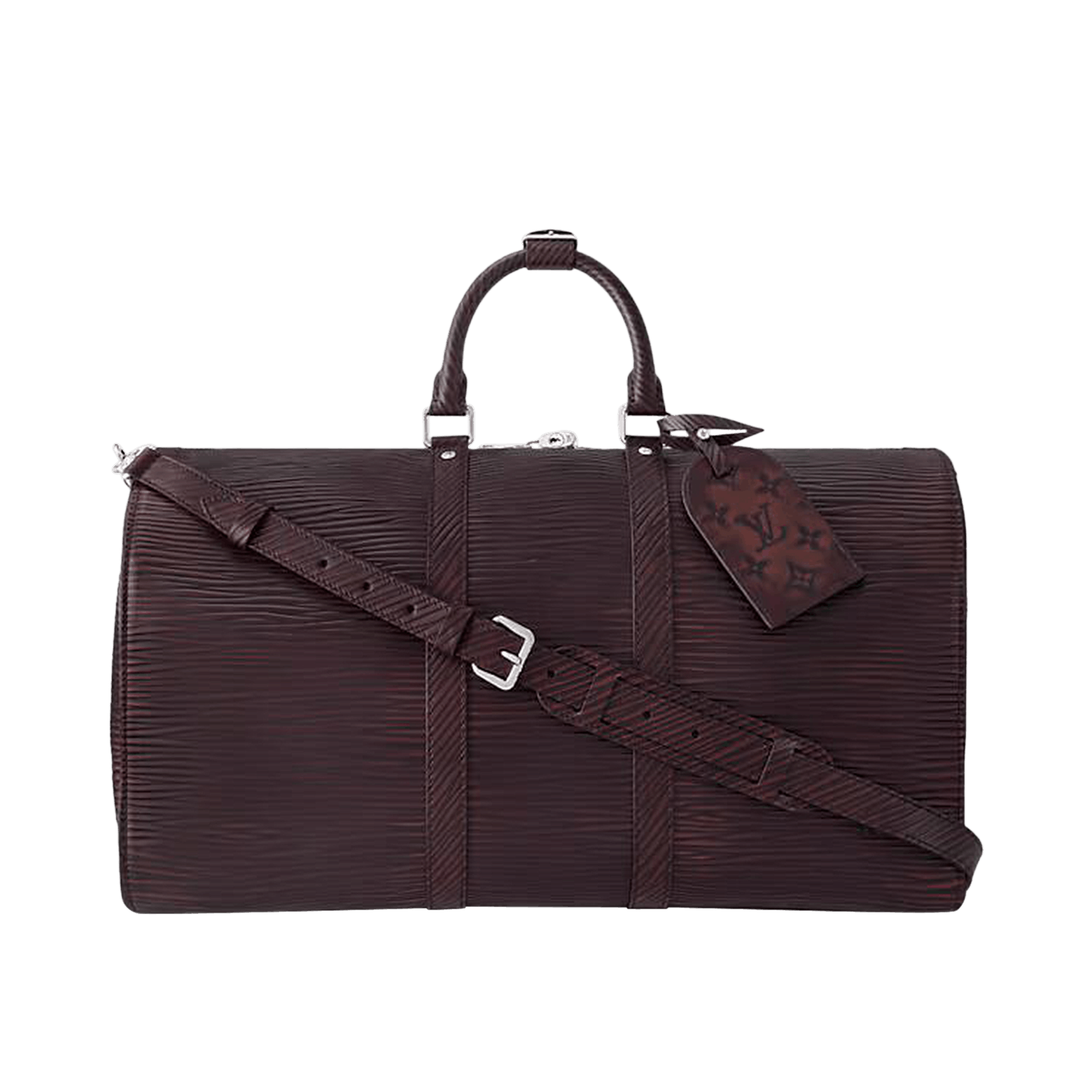
The Keepall is Louis Vuitton's original soft-sided travel bag, introduced in 1930 as a lighter alternative to the house's rigid trunks and the direct ancestor of the Speedy. Built in Monogram canvas with vachetta leather trim and a single long zip closure, it remains LV's flagship travel silhouette, especially in its detachable-strap Bandoulière configuration.
The smallest Keepall, sized for overnight or weekend essentials and small enough to wear crossbody via its strap. The most accessible entry point into the line.
A mid-small size balancing genuine packing capacity with everyday portability, popular as a gym or short-trip bag.
The classic weekender size and one of the most commonly seen configurations, offering enough capacity for a multi-day trip.
A larger format positioned between weekender and full travel duffle, used as LV's primary catalog listing image for the Keepall line.
The largest standard Keepall size, built for extended travel and functioning as a soft-sided carry-on alternative.
The original and most widely produced Keepall material. The most liquid option on the resale market across every size.
A durable, ridged-grain leather alternative to canvas. Commands a resale premium and was the material used for the celebrated 2017 Supreme x Louis Vuitton Keepall.
A technical, carbon-fiber-inspired checkerboard pattern aimed at a more understated menswear customer than classic Monogram.
Keepall resale value scales directly with size: the compact Bandoulière 25 typically resells for $1,300-$1,900 against a roughly $2,470 retail, while the largest 55 can reach $2,100-$3,200 against retail near $2,950-$5,250 depending on material. Across the size run, buyers can generally expect to recover 50-65% of current retail on a well-maintained Monogram canvas piece, making the Keepall one of LV's better resale holds relative to its accessible entry price. The clearest value play is the mid-size 45 or 50 in Monogram canvas, large enough for genuine travel use, small enough to remain everyday-practical, and consistently in demand on the secondary market.
Gaston-Louis Vuitton introduced the Keepall in 1930 at a moment when air and rail travel were making Louis Vuitton's traditional rigid steamer trunks impractical for a new generation of travelers. The Keepall answered that shift with a soft-sided, lightweight duffle built from the same Monogram coated canvas as the house's trunks, but flexible enough to collapse flat when empty, a genuinely new form factor for the brand. Its single long zipper, rolled leather handles, and small brass padlock became the template LV would later scale down into the Speedy handbag, making the Keepall the older, larger sibling of one of fashion's most recognizable silhouettes.
The bag has stayed close to its original construction for nearly a century, with most changes coming in size range and strap configuration rather than the core design. The Bandoulière version, which adds a long detachable shoulder strap for hands-free carry, has gradually become LV's primary configuration, today most sizes on louisvuitton.com are sold strap-included rather than as the classic handles-only bag. Sizes have also shifted over time, with the 25 and 35 becoming more prominent as crossbody-capable everyday bags rather than purely oversized luggage.
As the direct ancestor of the Speedy, the Keepall carries outsized historical weight in LV's catalog despite being less immediately recognizable to casual observers than its smaller sibling. It's a favorite among menswear and travel-focused collectors specifically because it reads as more functional and less overtly logoed than many of LV's other icons, while still being unmistakably a Louis Vuitton piece to those who know the brand.
The Keepall has also become one of LV's most frequent vehicles for high-profile collaborations and material reinventions, most famously the 2017 Supreme x Louis Vuitton collection, where an Epi leather Keepall Bandoulière 45 became one of the most coveted pieces of the entire collaboration. That crossover exposure, on top of nearly a century of continuous production, keeps the Keepall culturally relevant well beyond its original role as a practical travel bag.