
The 1st Camo Waist Bag applies BAPE's foundational camo print to a Cordura fabric belt bag with an adjustable waist strap and front zip pocket. It has appeared consistently across nearly every generation of BAPE's bag line, making it one of the brand's most recognizable recurring accessories.
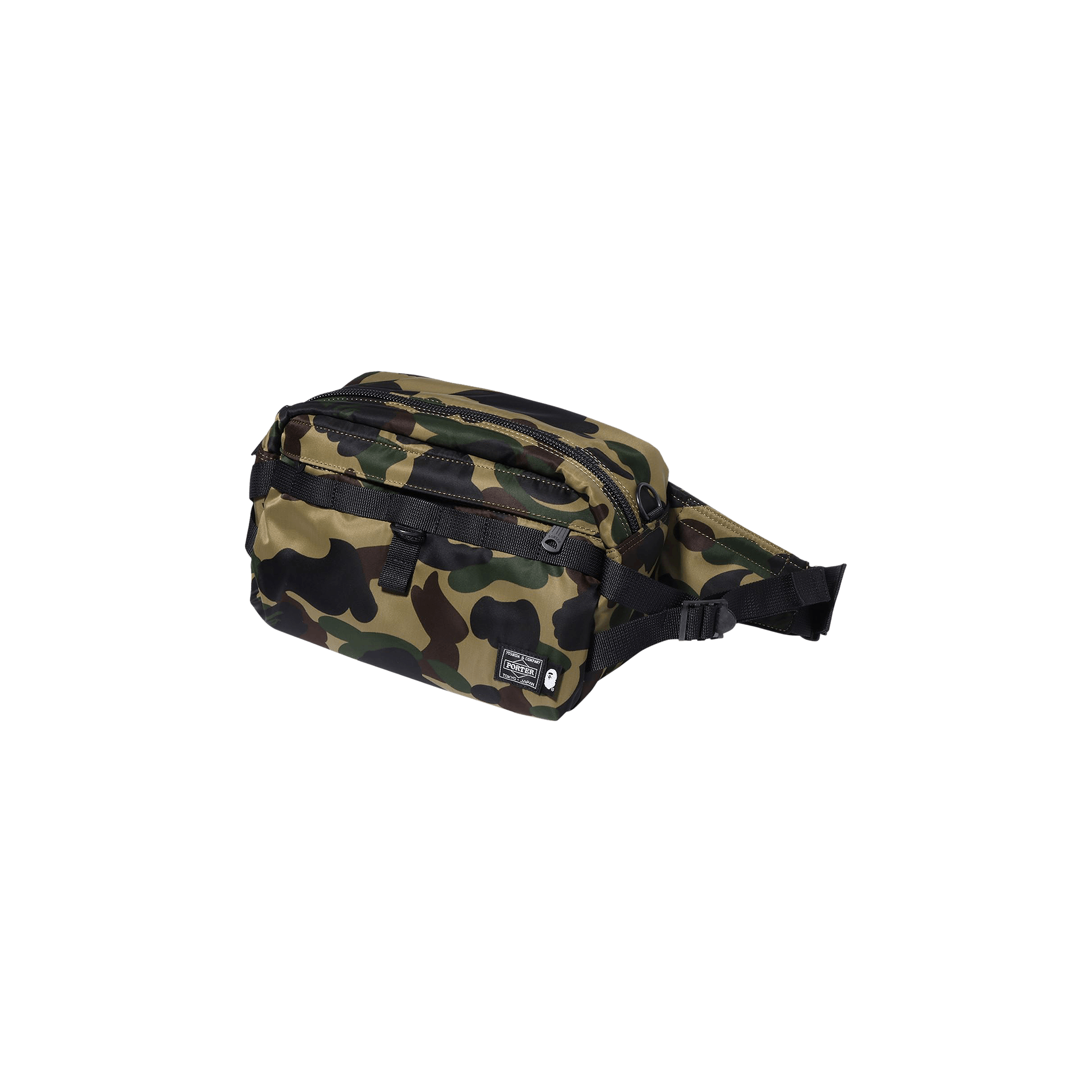
The original 1996 Olive Drab colorway and BAPE's most consistently restocked waist bag color. Trades below retail due to its wide availability across seasons.
The other original 1996 1st Camo colorway, restocked less frequently than Green. Its relative scarcity supports a consistent resale premium.
A collaboration with Japanese bag maker Porter (Yoshida & Co.), first released for SS18, featuring reinforced Cordura construction and Porter hardware. Commands the strongest resale premium in this family.
At $280 retail, the standard Green 1st Camo Waist Bag typically resells in the $150–$250 range on StockX, below original retail, which is common for a bag BAPE restocks almost every season. Yellow trades at a real step up, with asks generally in the $220–$320 range, reflecting its comparative scarcity next to Green. The clearest upside in this family comes from the BAPE x Porter collaboration version, which pairs the camo print with Porter's upgraded Cordura construction and can resell in the $300–$450 range, a meaningful premium over the standard bag. Because this is one of BAPE's most frequently re-released products, buyers chasing appreciation should focus on collaboration pieces or an older, no-longer-produced colorway rather than the current-season standard release, which is priced more like a everyday accessory than a collectible.
BAPE (A Bathing Ape) was founded in 1993 by Tomoaki "Nigo" Nagao in Tokyo's Ura-Harajuku district. The 1st Camo pattern debuted in 1996 in Green (Olive Drab) and Yellow (Sand Yellow), an abstracted, ape-head-derived camouflage designed to work as a proprietary BAPE motif rather than a copyable military print. As BAPE's apparel line grew through the late 1990s and 2000s streetwear boom, the waist bag, a compact, low-cost, easy-to-wear accessory, became one of the most consistently produced items in the camo bag range, appearing across nearly every seasonal update to the pattern.
Japanese bag maker Porter (Yoshida & Co.) has periodically collaborated with BAPE on elevated versions of the Waist Bag, including an SS18 BAPE x Porter release, pairing BAPE's camo with Porter's reinforced construction. The waist bag's simplicity and low retail price relative to BAPE's backpacks and shoulder bags has made it a common entry point into the brand's camo bag line, both at original release and on the resale market.
Waist bags in general became a hip-hop and streetwear staple through the 2000s and again in the 2010s revival of '90s style, and BAPE's 1st Camo version rode both waves, worn on-stage and in public by artists including Pharrell Williams (Nigo's longtime collaborator), Kanye West, and members of A$AP Mob. Its low price point relative to other BAPE bags made it an accessible way for fans to wear the camo pattern without the cost of a full jacket or backpack.
In Japan, the waist bag carries the same Ura-Harajuku associations as the rest of BAPE's camo line, a marker of the scene that also produced Undercover and Neighborhood, and of the queue-culture hype that defined Tokyo streetwear retail long before it spread globally. Because it's small, cheap to produce, and endlessly re-releasable, it also functions as one of BAPE's most repeated products season after season, which keeps it constantly visible on resale platforms even when demand for any single colorway is modest.