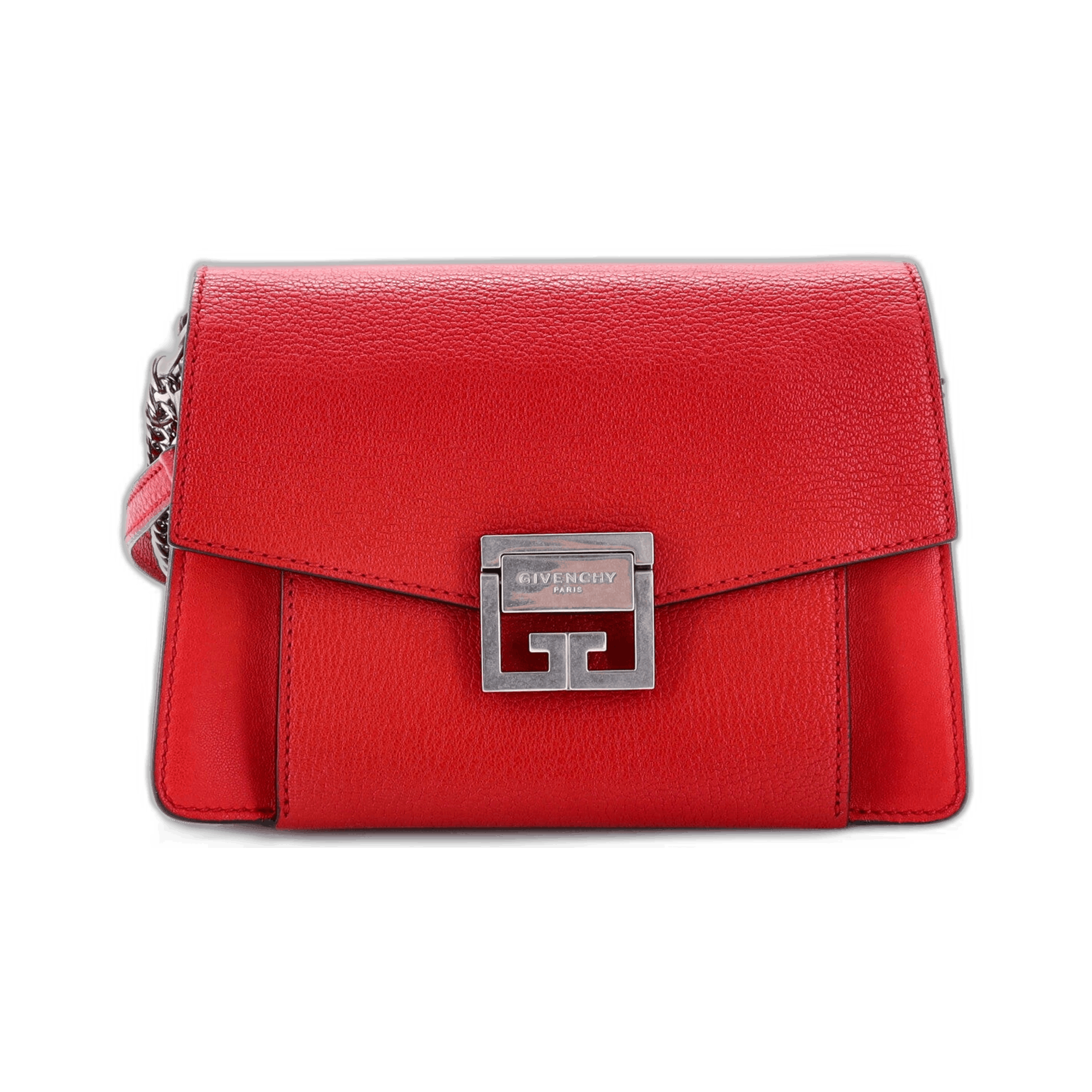
The GV3 is part of Givenchy's "GV Lines" product architecture, introduced for Spring/Summer 2018. Its defining trait is a flap silhouette closed with a signature gold-tone turn-lock clasp and finished with both a chain top handle and a decorative chain draped across the flap.
The smallest Nano size doubles as a belt bag, and the line is offered in grained leather and suede across the standard Givenchy size ladder.
The smallest size in the line, designed to double as a belt bag. Lowest retail entry point and the lowest resale ceiling of the range.
A small crossbody-oriented size for everyday essentials, positioned between the Nano and Small in both capacity and price.
The most commonly seen GV3 size on resale platforms, balancing capacity with the bag's shoulder-bag proportions.
The largest GV3 size, offering the most interior capacity and the highest resale ceiling of the range given its higher original retail price.
The primary GV3 material, offering better durability and slightly stronger resale demand than the suede version.
A suede version of the GV3 offered alongside the leather line. Suede is more prone to visible wear, which typically keeps its resale value at the lower end of the range compared to leather.
The GV3 retails from roughly $906 for the Nano to $2,390 for larger leather versions, and typically resells for $600–$1,300, or about 35–55% of MSRP depending on size and material, suede versions trend toward the lower end given durability concerns. That retention lags the Antigona and Pandora, which regularly hold in a similar or slightly higher percentage range despite being a decade older, because the GV3 never built the same depth of collector demand and was effectively superseded by Matthew M. Williams's newer hardware-driven lines within a few years of its release. The takeaway: the GV3 is not a bag to buy at retail expecting it to hold value, buying pre-owned is the better move, and there is little reason to expect appreciation the way there is with Givenchy's Tisci-era archive pieces.
The GV3 launched for Spring/Summer 2018 as the first major bag design credited to Clare Waight Keller, who had joined Givenchy the previous year as its first female creative director. Its name references 3 Avenue George V in Paris, the address of Givenchy's historic headquarters and a deliberate callback to the house's Parisian couture roots. Structurally, the GV3 was a departure from the Riccardo Tisci era that preceded it: where Tisci's signature bags (the Nightingale, Pandora, and Antigona) were satchels and top-handle shapes with minimal branding, the GV3 is a flap bag built around a large, visible gold-tone GG turn-lock clasp engraved with the Givenchy name, openly reviving logo-forward branding after more than a decade of understatement.
The line was offered across a Nano-to-Medium size run in grained calfskin and suede, with the Nano doubling as a belt bag, a style detail aimed at the late-2010s logo-belt-bag trend. When Matthew M. Williams succeeded Waight Keller as creative director in 2020, Givenchy's handbag strategy shifted again toward newer, hardware-driven lines such as the 4G and Antigona by MMW, and the GV3 was gradually deprioritized in the brand's current collections in favor of these newer silhouettes, though it remains findable through resellers and outlet channels.
The GV3 arrived at a transitional moment for Givenchy, immediately following Riccardo Tisci's twelve-year run and the appointment of Clare Waight Keller as his successor. It generated moderate press interest as a bellwether for the brand's post-Tisci direction and appeared in some influencer and street-style coverage around its 2018 launch, but it never reached the sustained it-bag status of the Nightingale, Pandora, or Antigona.
Its main cultural significance is as a marker of Givenchy's design pivot back toward visible logo hardware, a trend that would be picked up and amplified by Matthew M. Williams's subsequent 4G-branded lines. Compared to the archive-defining Tisci bags, the GV3 is more of a transitional footnote than a lasting icon, which is reflected in its comparatively soft resale demand today.