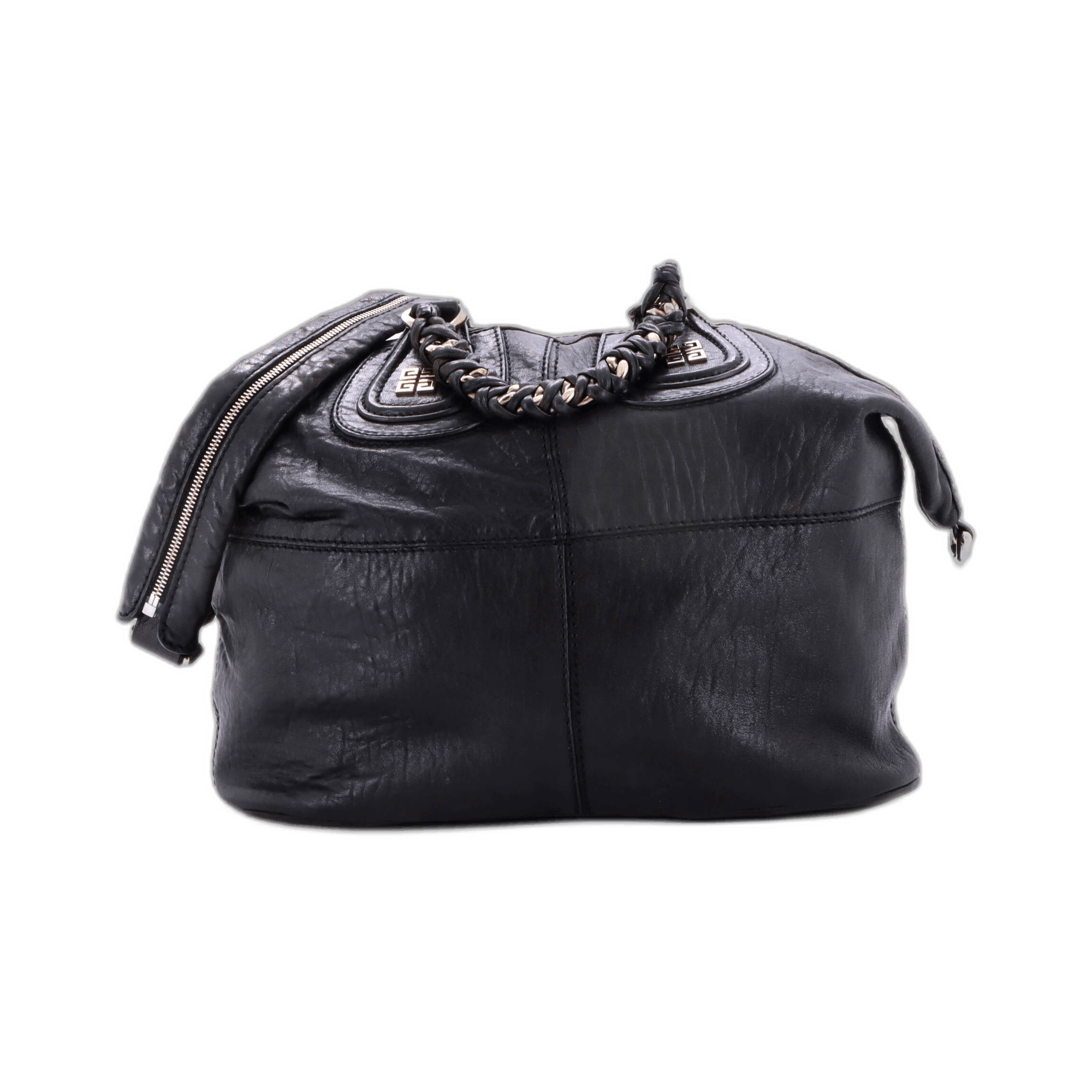
The Nightingale was Givenchy's first true it-bag under creative director Riccardo Tisci, introduced for Fall 2006. Its defining trait is a slouchy, cross-seam leather body finished with an oversized zip and embossed logo hardware where the handles attach.
Widely worn by the Olsen twins, Hilary Duff, Vanessa Hudgens, and Ashley Tisdale in the late 2000s, it helped establish Givenchy's modern handbag identity before being discontinued and sold today only on the secondary market.
The smallest Nightingale size, harder to find than the Small or Medium since it was produced in more limited runs. Lowest resale ceiling of the size range.
One of the two most consistently stocked sizes during the bag's production run. A practical everyday shoulder-bag size that remains the most commonly found size on resale platforms today.
The size most associated with the Nightingale's late-2000s it-bag moment and most frequently seen in period street-style photography. Commands the strongest resale demand of the range.
The largest Nightingale size, offering the most capacity but produced in smaller numbers than the Small or Medium, making clean examples harder to source on resale.
The original and most common Nightingale material, offering the crinkled, slouchy texture the bag is known for. Leather versions hold the strongest resale demand.
A lower-priced version of the Nightingale offered in nylon or canvas rather than leather. Less durable and less collected than the leather versions, so it resells for meaningfully less.
As a fully discontinued style with no current retail price, the Nightingale's resale value is driven entirely by size, leather quality, and condition rather than any comparison to an MSRP. Clean black calfskin or goatskin examples in the Small and Medium sizes, the two sizes most consistently available when the bag was in production, are the most liquid and typically sell for $600–$1,600. Micro and canvas/nylon versions sit at the lower end of the range, often $300–$700, reflecting both lower original retail pricing and softer collector demand for the non-leather versions. Because supply is fixed and shrinking as older bags wear out, well-maintained Medium leather examples have held their resale price more consistently over the past several years than many in-production Givenchy styles. The takeaway: if you find a clean Small or Medium in black leather, it's a reasonably safe buy for an archive piece; canvas and Micro versions are better suited to a Tisci-era completist than someone chasing resale value.
The Nightingale was Riccardo Tisci's first bag design after being named Givenchy's creative director in 2005, debuting for Fall 2006. It set the template for the gothic, cross-seamed leather aesthetic that would define his early tenure: four leather panels joined by perpendicular seams, an oversized top zip, and slouchy dual handles anchored by embossed logo hardware. It launched across a size run that eventually spanned Micro, Small, Medium, and Large, and in materials beyond smooth leather, including nylon and canvas versions aimed at a lower price point.
The Nightingale remained in production for several years as Givenchy's flagship handbag before being gradually phased out as Tisci's later designs, first the Pandora in 2009, then the Antigona in 2011, took over as the house's commercial focus. It was fully discontinued by the mid-2010s and has not returned to Givenchy's current lineup; every Nightingale available today is a pre-owned or vintage-market piece, with no current retail price. As the style that first proved Givenchy could produce a genuine handbag hit, it is often cited by resale specialists as the archive piece the brand's later commercial success was built on.
The Nightingale broke through in the late 2000s largely on the strength of young Hollywood: Mary-Kate and Ashley Olsen, Hilary Duff, Vanessa Hudgens, and Ashley Tisdale were all photographed carrying it repeatedly between 2007 and 2009, at a moment when paparazzi street-style photography was becoming a dominant force in how handbags achieved it-bag status. That sustained, repeated visibility, rather than a single red-carpet moment, is what pushed the Nightingale into cultural relevance.
Because it predates the smartphone-and-Instagram era of bag virality, the Nightingale's fame is now largely retrospective: it is remembered by collectors and fashion writers as the bag that established Givenchy's modern handbag identity and Tisci's gothic-luxury aesthetic, well before the Pandora or Antigona existed. Its discontinued status has only reinforced that archive-piece reputation, and it is frequently referenced in "throwback" coverage of 2000s it-bags.